
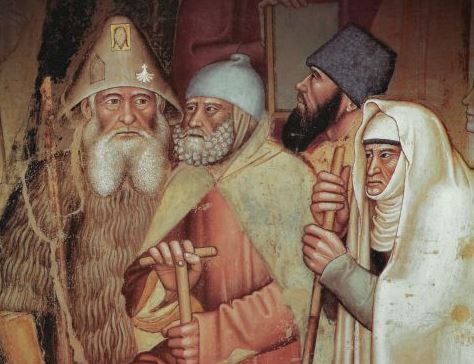
The year 2025 is a year of the Roman Jubilee. Far from forgetting or ignoring it, we at the Jacobean Foundation want to begin a series of posts on pilgrimages to Rome and their relationship with Santiago de Compostela.
We begin this series with an introduction to the concept of Peregrinationes Maiores (Major Pilgrimages), the name by which the pilgrimages to Santiago de Compostela, Rome, and Jerusalem were known for centuries. These are three major pilgrimage destinations that in the Middle Ages shared a substantial unity on a conceptual, spiritual, and ritual level.
The pilgrim experienced this unity between the three great interconnected pilgrimages, conceived as itineraries with continuity between them and articulated by various minor routes, constituting a sacred space for Christianity.
Among the three major pilgrimages, the Via Francigena, which crosses Italy toward Rome, constitutes almost the heart of this sacred space, allowing pilgrims to travel north on the road to Santiago de Compostela, or south to embark for the Holy Land on their way to Jerusalem.
In reality, as Paolo Caucci von Saucken wrote so often, it was in fact a single route, simultaneously a route of St. James, a route of pilgrimage, and a route of Jerusalem. Over the centuries, bridges and hospitals were built, and pilgrim brotherhoods were created which allowed these routes to be travelled in both directions, facilitating the passage and the welcoming of pilgrims.
The Christian ‘caritas’, of which Saint Benedict spoke in his rule, found a privileged place on the pilgrimage routes linked to these three sacred goals or cities. We see this clearly in the Codex Calixtinus, the main compilation of liturgical texts, miracles, and other documents relating to the Way of St. James, which continually alludes to the other great pilgrimages, making it clear that they form a single world. For example, when referring to the main pilgrim hospitals, it includes not only one relating to the roads to Compostela, but also the most notable ones relating to Rome and Jerusalem.
This unity among the three major pilgrimages was understood by pilgrims who, on many occasions, attempted to achieve all three goals throughout their lives or, at least, to include references to the roads to Rome, St. James, and Jerusalem in their writings and pilgrimage itineraries. This was the case with the so-called Lord of Caumont, Jean de Tournai, Bartolomeo Fontana, Arnold von Harff, and Domenico Laffi, whose pilgrimage itineraries we have discussed or will discuss in our section “Pilgrimages that Left Their Mark.”
The graves of pilgrims have also left a mark of this reality, such as the famous tombstone of Jonah, a Dane who had the fact that he had completed the pilgrimage to Jerusalem twice, to Rome three times, and to Santiago once engraved on it.
The interdependence between the paths to Rome, Santiago, and Jerusalem continues today as it did yesterday. In fact, many pilgrims dream of completing such an adventure, an adventure also experienced in the 20th century by pilgrims like Laurie Dennett, whom you can also listen to on our website.
A single culture that accompanies all pilgrims, a series of patron saints, rites, liturgies, legends, and shared mystics, transmitted in the past in a medieval Latin that somehow lives on today in that language of the heart in which pilgrims manage to communicate along the roads. The coincidence of these anniversaries, with the current Roman Jubilee and the upcoming Holy Year of Compostela, invites us to remember this reality – that of calling pilgrims to embark upon a great journey ad limina apostolorum.